At some point in a conversation about managed IT services, someone usually asks a version of the same question.
“If AI is monitoring our systems around the clock, what exactly does a human IT team do?”
It’s a reasonable question, and the answer matters if you’re trying to evaluate what you’re actually getting from a managed services provider in 2026.
The short version: AI and human IT professionals are good at different things. The gap between a strong managed IT provider and a mediocre one isn’t which tools they use—everyone has monitoring tools now. The gap is in how effectively human judgment and AI capability work together.
What AI Monitoring Actually Does
Modern network monitoring tools powered by AI do things human teams genuinely cannot. They watch thousands of data points simultaneously—network traffic patterns, login behaviors, device health metrics, file access activity, endpoint events—without fatigue, distraction, or working hours.
They detect anomalies in milliseconds. A login attempt from an unusual location at 3 AM registers immediately. A sudden spike in outbound data transfer triggers an alert before a human analyst has seen it. A pattern of failed authentication attempts that suggests credential stuffing surfaces across multiple systems at once.
For high-volume, pattern-matching work, AI doesn’t perform as well as human analysts. It outperforms them. Speed, consistency, and the ability to correlate signals across systems that a human might not connect until hours later are genuine advantages that AI monitoring tools deliver.
These capabilities are real. Any managed IT provider worth working with uses them.
Where AI Monitoring Falls Short
Here’s what doesn’t show up in the product demo.
AI monitoring tools surface signals. They identify what looks anomalous based on patterns. But they have no way of knowing whether an anomaly is actually a problem or whether context makes it expected and harmless.
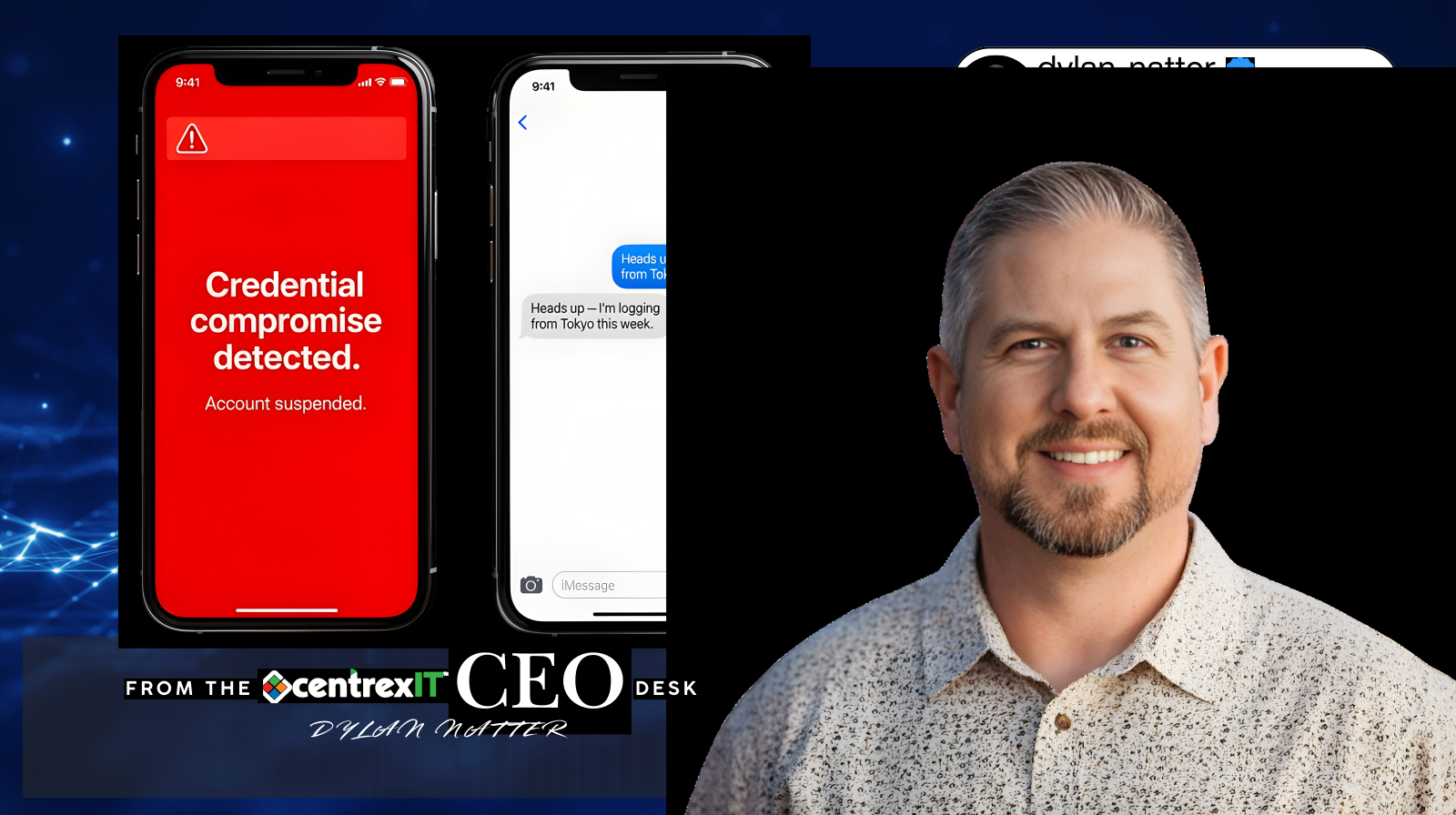
A login from an unfamiliar location at an unusual hour looks identical whether it’s an attacker who stole a credential or your CFO logging in from a hotel in Tokyo where she’s attending a board meeting she mentioned to your IT team two weeks ago.
The monitoring system sees the same data either way. An automated response treats both situations identically. A human team that knows your business knows the difference.
This is the gap that separates AI monitoring from AI-amplified IT support: context. The knowledge of who your people are, what your business does, what’s unusual versus what’s legitimately different, and when acting on an alert would create more problems than it solves.
<<Take Our 2-Minute Security Assessment>>
centrexIT has helped organizations build layered IT and security programs since 2002. If you want to understand where your current monitoring setup has gaps, we can help you find them quickly.
What Human IT Teams Actually Do
In an AI-augmented IT support model, human professionals are not doing what AI does, slower. They’re doing what AI can’t do at all.
They maintain the relationships and context that make alert triage meaningful. They know which users handle sensitive data regularly and which ones triggering a data access alert are behaving unexpectedly. They know which systems are undergoing planned changes and which change represents a problem.
They make judgment calls on ambiguous situations. Is this a security incident or a configuration issue that needs to be escalated to a vendor? Is this user behavior suspicious or does it fit a pattern that’s been discussed? Is this network anomaly a threat or a large file transfer that someone mentioned last week?
They handle the communication and coordination that happens when something goes wrong. Keeping stakeholders informed. Working with vendors when issues involve third-party systems. Explaining what happened and what it means to people who aren’t IT professionals.
They review what AI surfaces and decide what to do about it. Not every alert warrants the same response. Prioritization, escalation decisions, and the judgment about when to wake someone up at 3 AM versus when to handle it quietly without disrupting anyone—these decisions require human judgment about business context that AI doesn’t have.
The Research on Human-AI Collaboration
The case for combining human expertise with AI tools isn’t theoretical. Harvard Business School researchers studying 791 professionals at Procter & Gamble found that human teams working with AI outperformed all other groups—including individuals using AI and teams working without it. The researchers described AI as capable of acting as a “cybernetic teammate,” but concluded that for top-tier performance, a full human team plus AI is the combination that wins.
The finding isn’t that AI replaces team members or that teams can be smaller. It’s that the combination produces outcomes neither can reach independently. In managed IT, that translates directly: AI provides the speed and coverage that human-only monitoring can’t match, and the human team provides the context and judgment that make monitoring data meaningful.
What to Ask Your Managed IT Provider
As AI becomes standard in managed IT services, the right question isn’t whether a provider uses AI monitoring tools. Almost everyone does or will soon. The questions that actually differentiate providers are:
Who reviews the alerts that AI surfaces? Is there a human team evaluating what AI flags, or are automated responses handling incidents without human oversight?
How do they account for context? What happens when an alert fires for a situation that has a benign explanation? Does the team know your business well enough to recognize those situations?
What’s the escalation path? When does human intervention happen, and who makes that call?
How do they handle the situations AI isn’t designed for—the communication, the coordination, the judgment calls that require understanding your business, not just your systems?
The answers to these questions tell you more about the quality of a managed IT relationship than the technology stack does.
The centrexIT Model
When we describe centrexIT as “People-First. AI-Amplified.” this is the operational reality behind that positioning.
AI handles the watch. Our team makes the calls. AI provides speed and coverage that human-only monitoring can’t match. Our team provides the context, judgment, and relationships that transform monitoring data into actual protection.
Neither component works as well without the other. The combination produces IT support that knows your business—not just your systems—and responds accordingly.
Since 2002, the foundation of how we work has been the same: real people who know their clients, supported by the best tools available. AI changes the tools significantly. It doesn’t change the foundation.
See Where Your Current IT Setup Stands
Take the 2-Minute Cybersecurity Assessment: https://centrexit.com/cyber-security-readiness-assessment/
Source
- Dell’Acqua, F., Ayoubi, C., Lifshitz, H., Sadun, R., Mollick, E., et al. “The Cybernetic Teammate: A Field Experiment on Generative AI Reshaping Teamwork and Expertise.” Harvard Business School Working Paper, No. 25-021, 2024. Available via Harvard Business School Working Knowledge: https://www.library.hbs.edu/working-knowledge/when-ai-joins-the-team-better-ideas-surface