The Call Sounded Legitimate. It Wasn’t.
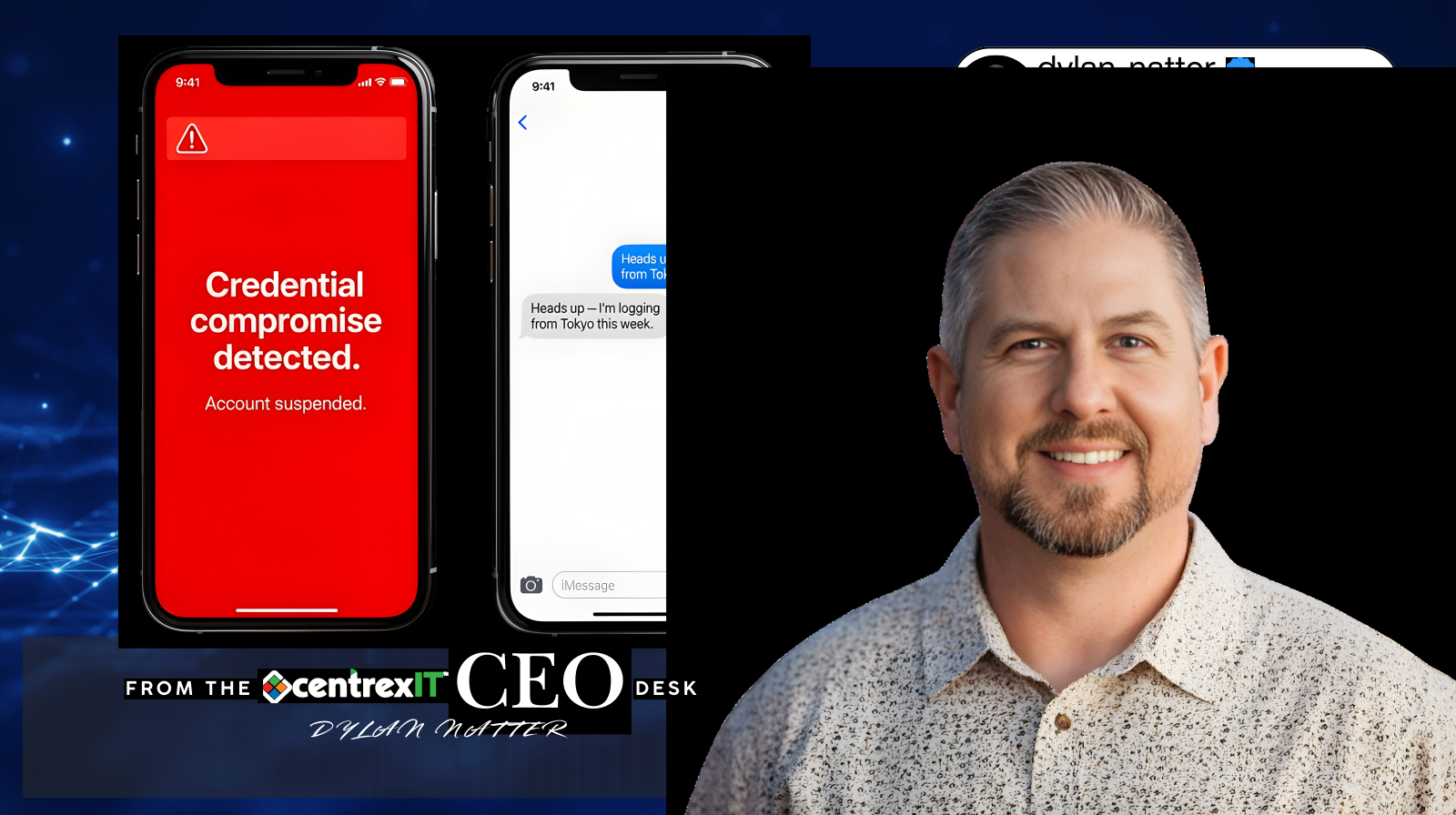
Someone called CarGurus’ IT helpdesk and said they were an employee who needed help accessing their account. They knew enough to sound convincing — the right terminology, the right context, the right urgency. The helpdesk did what helpdesks do: they helped.
On February 13, 2026, that phone call gave attackers access to CarGurus’ systems. By February 21, the notorious extortion group ShinyHunters had published a 6.1 gigabyte archive of stolen data on their dark web leak site. Have I Been Pwned confirmed the breach contained more than 12.5 million records — names, email addresses, phone numbers, physical addresses, IP addresses, finance pre-qualification application data, and dealer account information.
CarGurus confirmed the incident in a statement to TechCrunch: the company “experienced a cybersecurity incident,” secured the affected environment, and engaged a forensic firm to investigate. They noted the activity appeared contained and limited in scope — but the data was already public.
CarGurus is not an isolated incident. It is the latest in a pattern.
The ShinyHunters Playbook: How a Phone Call Bypasses Your Technical Controls
ShinyHunters is a prolific extortion group that has refined a remarkably straightforward attack model. They don’t need to find a software vulnerability. They don’t need to deploy malware. They call your helpdesk and ask for access.
The technique is known as vishing — voice phishing. In ShinyHunters’ version, attackers call IT helpdesks or SSO support lines and impersonate employees who need their single sign-on credentials reset. When the helpdesk resets or bypasses authentication, the attackers obtain a valid access code for Okta, Microsoft, or Google SSO — which then opens the door to connected systems, data, and files.
The same technique was used in a string of high-profile breaches in early 2026. According to reporting by The Register and SecurityWeek, the ShinyHunters-affiliated campaign in this period also compromised Betterment, Panera Bread, Match Group (including the dating platforms Hinge, Match.com, and OkCupid), CarMax, Edmunds, investment advisory firms Mercer Advisors and Beacon Pointe Advisors, and fintech lending platform Figure Technology Solutions.
Different companies. Different industries. Same phone call.
Curious About Where You Stand? Take the 2-Minute Cybersecurity Assessment
Why This Attack Works — and Why Technical Controls Don’t Stop It
The uncomfortable truth about vishing attacks is that they succeed precisely because your technical controls are working. Multi-factor authentication, SSO platforms, and identity verification systems are doing exactly what they’re designed to do — they’re protecting access behind a human verification step. And then an attacker convinces that human to open the door.
According to the Verizon 2025 Data Breach Investigations Report, the human element was involved in 60% of all breaches analyzed — whether through errors, social engineering, or manipulation. That number has remained stubbornly consistent across years of increasingly sophisticated technical defenses. Technology has not closed the human gap. It has, in some ways, made the human gap more valuable to attackers.
When every digital access point requires a human to verify identity, compromising that human becomes the most efficient path into the system. ShinyHunters has built a business model around exactly that insight.
The specific vulnerability in these attacks is often the culture of helpfulness that makes IT teams effective. Helpdesks exist to solve problems for employees. They are trained to be responsive. They work under pressure to resolve issues quickly. When someone calls with a plausible story and the right information — an employee name, a department, a manager’s name, details found in a LinkedIn profile or previous breach — the instinct to help can override the instinct to verify.
What These Breaches Have in Common
Looking across the companies hit by the ShinyHunters campaign, a few patterns emerge.
First, all of them used SSO platforms — Okta, Microsoft, or Google — as their primary authentication layer. SSO is a security improvement over independent credentials for every application. But it also means a single compromised access point can open multiple connected systems simultaneously. The more valuable your SSO access is, the more valuable it is to an attacker who can social engineer their way to it.
Second, none of the breaches involved a technical exploit in the traditional sense. No zero-day vulnerability. No malware. No sophisticated intrusion chain. A person on a phone convinced another person to provide access. The investment required to launch this attack is minimal. The potential return is enormous.
Third, the organizations targeted span every industry: automotive, financial services, food service, entertainment, investment management. ShinyHunters is not targeting specific sectors. They are targeting any organization where a helpdesk phone call is part of the credential recovery process.
Three Controls That Actually Defend Against Vishing
Technical security controls are necessary but not sufficient against social engineering. The organizations that defend against vishing attacks successfully combine procedural controls with cultural expectations.
1. Out-of-band identity verification for credential resets. Before any credential is reset or authentication is bypassed over the phone, require the caller to verify identity through a separate channel — a pre-registered email, a manager approval, a callback to the employee’s documented number. The verification step cannot be completed using information the caller provides during the call itself. “I’m calling from IT, here’s my employee ID” is not verification.
2. Phishing-resistant MFA for privileged access. Standard MFA — one-time codes, push notifications, number matching — can be bypassed through social engineering. Phishing-resistant authentication methods, such as hardware security keys or passkeys, require physical possession of a registered device and cannot be transferred over a phone call. For your highest-value access points, standard MFA is no longer sufficient.
3. Empower employees to slow down and verify. Helpdesk staff need explicit permission — and organizational backing — to refuse a credential reset when verification cannot be confirmed. Urgency is a social engineering tool. Attackers who claim they’re locked out of something critical and need access immediately are using pressure to override procedure. A culture where “I need to verify this before I can help you” is the expected and supported response is one of the most effective defenses against vishing.
The Cost of Getting This Wrong
According to IBM’s 2025 Cost of a Data Breach Report, the average cost of a breach for U.S. organizations reached a record $10.22 million. CarGurus has not disclosed the financial impact of their incident. But for context: the 12.5 million records stolen include finance pre-qualification data — information that could be used for targeted fraud, identity theft, and follow-on phishing attacks against people who were simply shopping for a car.
The cost is not just financial. ShinyHunters’ model includes public shaming — posting stolen data when extortion fails, as they did with CarGurus. The reputational damage, customer notification requirements, and regulatory scrutiny that follow a public breach add costs that go well beyond the immediate incident response.
A phone call costs an attacker almost nothing. The verification procedures that stop that call cost an organization very little to implement. The math argues strongly for getting the procedures right before the call comes in.
centrexIT has protected businesses since 2002. If the CarGurus breach raises questions about your own helpdesk procedures or SSO security posture, we can help you find out where you stand.
Take the 2-Minute Cybersecurity Assessment
Sources
- TechCrunch: “CarGurus data breach affects 12.5 million accounts” — February 24, 2026
- SecurityWeek: “CarGurus Data Breach Impacts Over 12 Million Users” — February 25, 2026
- The Register: “ShinyHunters claims it drove off with 1.7M CarGurus records” — February 2026 (includes other victim list: Betterment, Panera Bread, Match Group, CarMax, Edmunds, Mercer Advisors, Beacon Pointe Advisors)
- Have I Been Pwned: CarGurus Data Breach — breach verification, 12M+ email addresses confirmed
- Verizon: 2025 Data Breach Investigations Report — human element involved in 60% of all breaches
- IBM: Cost of a Data Breach Report 2025 — U.S. average breach cost $10.22M